Group photo
A Personal Injury, Workers' Compensation and Defense Base Act Law Firm Fighting for the Injured.
Published on:

Are ex parte communications between a nurse case manager and a physician permissible?  The answer to this question truly depends on whether the nurse case manager is a qualified rehabilitative provider performing a reemployment assessment or if the nurse case manager is solely retained to perform medical care coordination services.  If the nurse case manager is a “qualified rehabilitation provider” and retained to perform a re-employment assessment,  then ex parte communications are appropriate and allowable pursuant to Florida Statue 440.13(4)(c).    Conversely, if the nurse case manager is retained by the employer or the carrier for the sole purpose of medical care coordination, ex parte communications are impermissible and a violation of the statute.  It is important to note that just because the nurse case manger is deemed a “qualified rehabilitation provider” that does not, in and of itself, permit ex parte communications between she and the physician.

While Florida Statute 440.13 (4)(c), allows the employer and or the carrier to have ex parte communications with the physicians, this statute does not extend to third parties or a qualified rehabilitation provider who is not performing a reemployment assessment.

If you have been assigned a nurse case manager, it is important to understand her role.  If you are unsure, please do not hesitate to contact our office as we would be more than happy to speak with you.

Published on:

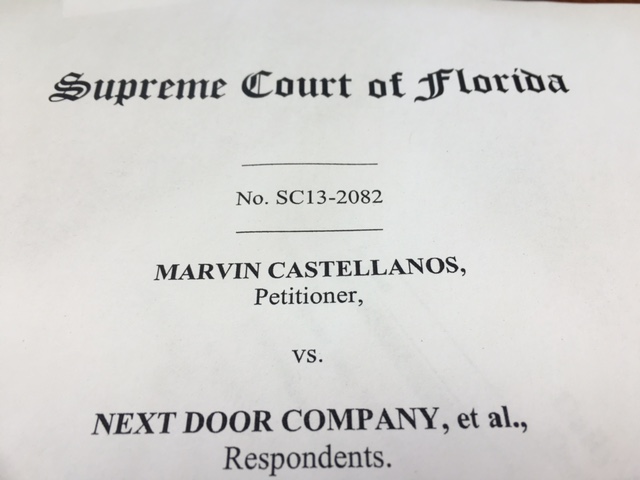
On 4-28-16, the Florida Supreme Court in the case of Castellanos v Next Door Company SC 13-2082 declared Florida Statute 440.34 unconstitutional because it violated the Constitutional due process right to the courts for the injured workers. The constitutional violation was based on the failure of that statute to allow claimants’ attorneys to obtain a reasonable attorney fee for litigating and obtaining benefits under the Florida Workers Compensation Act.  This is a victory for the injured workers as their attorneys can now receive reasonable compensation for obtaining needed benefits for the injured workers.

IMG_3841

This firm has always been dedicated to protect the rights of the injured person. Angel Kirkconnell at this firm has litigated tirelessly to help the injured worker.  Now with the advent the ability of attorneys to get paid, this firm can give meaningful help to achieve benefits for those injured in the line of work.

Continue reading →

Published on:

An important decision regarding a business’ duty to prevent over serving has been released by the 4th District Court of Appeal in the case of Stephanie De La Torre, Humberto Miranda and Carla Gallardo, Appellants, vs. Flanigan’s Enterprises, Inc d/b/a Flanigan’s Bar and Grill.

In this decision, the Plaintiffs, Stephanie De La Torre, Humberto Miranda and Carla Gallardo, were injured when their vehicle was hit by a drunk driver.  The injured persons filed a complaint against Flanigan’s, which owns and operates the restaurant at which the drunk driver had been drinking at prior to the accident.

blogThe trial court dismissed the complaint, finding that section 768.125, Florida Statutes (2011), protects businesses such as Flanigan’s from any liability for injuries caused by intoxicated patrons, as long as certain conditions are met.
The facts of this case, are unfortunately, not uncommon.  The Defendant went to the restaurant, Flanigan’s, on the night of December 2, 2011.  While there, the Defendant was over served by employees of Flanigan’s.  The Defendant became intoxicated and the employees of Flanigan’s tried to sober the Defendant up.  Later on, the Defendant left the restaurant in her own vehicle, and while on her way home, crossed into oncoming traffic, and struck the Plaintiffs’ vehicle.

An important part of this case, is the fact that Flanigan’s maintained internal policy designed to prevent drunk patrons from driving away from the business, by in effect taking the car keys away from the intoxicated patrons and insuring that the drunk patron left in either a taxi or with a sober driver. Continue reading →

Published on:

dwc 25As we know, the law requires that a medical benefit which includes, but is not limited to, the treatment, a device or an aid be medically necessary.  In order to award that benefit, the test is whether it is medically necessary.  A Judge of Compensation Claims may award only those medical benefits that are medically necessary.  It is important to understand the distinction between a medically necessary benefit and those that are merely pleasant or convenient.  Simple convenience will not suffice nor would a benefit that would neither improve nor aid in recovery be considered medically necessary. Continue reading →

Published on:

In yesterday’s blog we referenced Attorney Hoffman’s early experience in successfully picking stocks in which to invest.  An IBD Special Report from June 29, 2001 explaining her methodology.  Jo Ann Hoffman’s expertise in business has been said to help her obtain the best possible settlements for her clients.  Firm-Photo-2014-1024x731Her team work together with each client to obtain the best settlements.


Continue reading →

Published on:

If you review the graph at the bottom of this article you will see that as the price of oil goes so goes your investments. My solution is to stabilize the stock market and global economies by having the U.S.  set the price of oil at $45 per barrel. At the current price of plus or minus $30 per barrel, oil companies are losing money by pumping oil. In Ohio, it costs approximately $900,000  to drill a 4800 foot well that produces both oil and natural gas. The bankers are calling in the loans extended to the oil drillers and of course the oil drillers can’t pay so they will go belly up. The wells will not be maintained and the weak wells with little production will have to be shut in (sealed off) by the state as they are abandoned or else it will cause pollution. The taxpayer will pay that shut-in expense and the unpaid financial loans will bring down the financial institutions’ profit. All will cause greater economic turmoil and our stock market will fall further if oil pricing isn’t stabilized.  Why not ask the Saudi’s to stabilize oil?  They only produce 1/9th of the world’s oil so they can’t do it alone. The United States leads in oil production and we must lead the way. Consider the below chart showing oil production by country.  Even though some of the 13 Nation OPEC countries along with Russia are talking about not producing more oil (premised on other large producers such as Iran, Iraq  joining), the Unites States needs to be a part of such an agreement as we are the number one oil producer right now.

Continue reading →

Published on:

This discussion will center on Federal Liens which you need to be aware of and handle with common sense.  So put the Federal lienholder on notice of a third party claim and settlement as you can pay them back a portion of money they paid for the related medical treatment and Federal compensation benefits when the case settles.

blog

Federal liens include:

The US Dept of Labor under the Division of Federal Employees’ Compensation Act (FECA) §8131 provides for a lien if the Federal employee received Federal compensation for lost wages that are an element of the damages in a personal injury case.  The Statute states: Continue reading →

Published on:

What happens in your Longshore or Defense Base Act (DBA) claim if you re-injure yourself working for a different employer after your initial accident?

The answer, like many legal questions, is “it depends.” If a Claimant’s disability results from the natural progression of a prior injury and would have occurred notwithstanding a subsequent injury, the prior injury is a compensable injury and the Claimant’s employer at the time of the prior injury is responsible. This was the holding in Wallace v. Cerris Marine Terminals. Consequently, if the subsequent injury is one that was natural and unavoidable as a result of your initial injury, the initial employer will be paying your benefits under the Longshore Harbor Workers’ Compensation Act and/or the Defense Base Act. If, however, the subsequent injury aggravates, accelerates or combines with the earlier injury to result in the Claimant’s disability, the subsequent injury is a compensable injury and the subsequent employer is responsible. This is what is commonly referred to as the “Aggravation Rule”, and it can cause numerous problems in obtaining benefits under the Longshore Act.

If you suffer an injury with one employer and begin working with another covered employer, the insurance carrier for the initial employer may thereafter stop benefits if they have reason to believe that you have aggravated your injury with the new employer. If the insurance ceases paying benefits based on this Aggravation Rule, the insurance carrier for your new employer will have to be notified of this claim, and a determination of which carrier is responsible will ultimately be made by an Administrative Law Judge. Continue reading →

Published on:

gavelsmallerThe answer to this question is – NO.  The 1st District Court of Appeals recently addressed this question and issued an opinion which can be found in Boley Centers, Inc./Comp Options v. William Vines, Case No. 1D14-5869 (November 16, 2015). Continue reading →

Published on:

According to Fla. Stat. 440.13(2)(f), “Upon the written request of the employee, the carrier shall give the employee the opportunity for one change of physician during his course of treatment for any one accident. Upon granting of a change of physician, the originally authorized physician in the same specialty as the changed physician shall become de‑authorized upon written notification by the employer or carrier.  The carrier shall authorize an alternative physician who shall not be professionally affiliated with the previous physician within five (5) days after receipt of the request.  If the carrier fails to provide a change of physician as requested by the employee, the employee may select the physician and such physician shall be considered authorized if the treatment being provided is compensable and medically necessary.

As of late, there has been some controversy as to whether the physician must be in the same specialty as that of the treating physician. As you will note from the Statute, same does not contain any requirement whatsoever that the one-time change must be in the same specialty.  In fact, said issue was recently addressed in Edwards v. Miami-Dade County Public Schools, OJCC #15‑009693CMH.  In Edwards, Judge Hill ruled that Fla. Stat. 440.13(2)(f), does not require the Claimant to first prove as a condition precedent to the operation of this subsection, that all the proposed treatment be within the same medical specialty.

As you will note, in the most recent case, it is evident that the Statute is devoid with regard to specific language pertaining to whether the one-time change must be within the same specialty. As such, it is our position that once a one-time change has been made, the Claimant may be free to choose any specialty and may not compelled to change to the same specialty.

Contact Information