Group photo
A Personal Injury, Workers' Compensation and Defense Base Act Law Firm Fighting for the Injured.
Published on:

In Florida, following the Supreme Court decision in Daubert v. Merrell Dow Pharmaceuticals, Inc., 509 U.S. 579 (1993), you must object to an expert, such as a doctor, when his testimony does not comply with Fla. Stat. 90.702.  Your specific objection under Daubert is 1) the expert’s testimony is based on insufficient facts, 2) is not based on reliable principles, or 3) that the witness has not applied the principles and methods reliably to the facts of the case.

IMG_0284The Daubert case establishes that the judge is the gatekeeper pursuant to Fla. Stat. 90.702 to only allow scientific expert testimony at trial.  Toward that end, the attorney must lodge specific objections so that the other side is aware of the defect and will thus have the opportunity to cure it during the expert’s or doctor’s deposition.

However, that is only the first part of the requirement to successfully disqualify the doctor or part of his testimony. The next part is that the attorney must file a Motion to Strike the doctor as a witness or a Motion in Limine to limit the doctor’s testimony to areas that comply with the requirements under Fla. Stat. 90.702.  This means an expert’s testimony is dismissed if it is pure opinion.  Virtually every expert’s opinion is subject to a Daubert analysis.  The proponent of the expert opinion has the burden of establishing by a preponderance of the evidence that the opinion is admissible. Continue reading →

Published on:

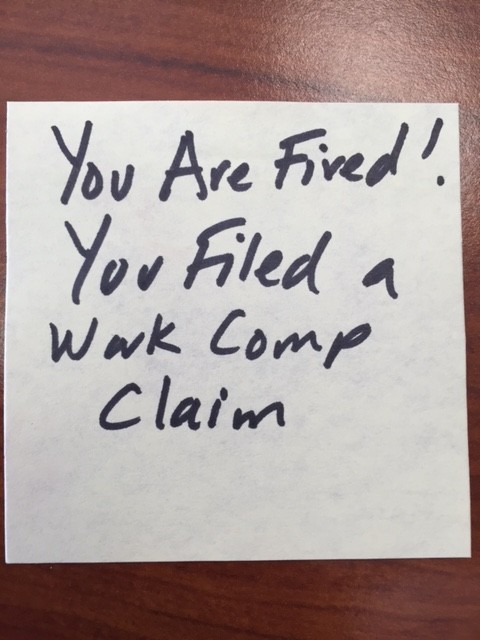
Under  the Florida workers’ compensation statute, F.S.A. 440.205, a terminated employee can sue where an employer has fired the employee for exercising his valid claim for workers’ compensation benefits.  Fla. Stat. 440.205 states:

440.205 Coercion of Employees.  No employer shall discharge, threaten to discharge, intimidate, or coerce any employee by reason of such employee’s valid claim for compensation or attempt to claim compensation under the Worker’s Compensation Law.

IMG_1772A cause of action can be filed in the Florida Circuit Court based on the case of Smith v. Piezo Technology, 427 So.2d 182 (Fla. 1983).  The terminated employee must show that he made a workers’ compensation claim that was valid and that he was terminated due to making that claim.  This can generally be found by a termination  shortly after filing the claim. Continue reading →

Published on:

While there are no statutory or regulatory provisions requiring a Worker’s Compensation Medicare Set-Aside (WCMSA) proposal be submitted to CMS for review, in all cases, submission of a WCMSA proposal is a recommended process and in some cases a required process.

If you choose to submit a WCMSA for review, CMS requests that you comply with its established policies and procedures.  CMS will only review new WCMSA proposals that meet the following criteria: Continue reading →

Published on:

As a general rule, the Judge of Compensation Claims can only consider the testimony of authorized doctors. Likewise, the Judge is limited to determining if the injured worker is owed any benefits in the past for medical care and/or lost wages. Also if a claim was filed for medical treatment to be approved the Judge can decide if the insurance company should provide that requested treatment.

The Judge of Compensation Claims has no jurisdiction over fees charged by an authorized medical provider. Judge Almeyda noted in the case of Maqueira v. FrankCrum, OJCC 07‑009035ERA that AHCA has exclusive jurisdiction over that issue. Continue reading →

Published on:

back-injuryA represented employee can settle his workers’ compensation case by signing a release of his workers’ compensation claim in ANY third party litigation cases including:

  • An EEOC claim decided March 6, 2015 by Judge Sojourner: Bond v. Hilton Garden Inn/Travelers, OJCC 15-002240MES.
  • A general release in a separation agreement RELATED to the employment relationship with the employer. Risco USA Corp. v. Alexander, 91 So.3d 870, 872 (Fla. 1st DCA 2012).
  • A general release of the employer in a negligence action against a coworker who rearended him. Patco Transport, Inc. v. Estupian, 917 So.2d 922 (Fla. 1st DCA 2005). Continue reading →
Published on:

gavel-3-1236445Issues that are outside of FSA 440 and issues over which the JCC has no jurisdiction per case law and recent JCC decisions:

  1. The JCC lacks jurisdiction over all employment benefits between the employee and the employer including reinstatement of medical leave benefits, vacation, or sick leave as those issues are between the employee and the employer. Spinelli v Fla. Dept of Commerce, 490 So.2d 1294,1296 (Fla 1st DCA 1986)
  2. As 440.39 (3) (b) states the JCC has no jurisdiction to resolve a dispute over the worker’s compensation carrier’s lien and payback from the claimant’s settlement against the at fault party. Such jurisdiction rests with the Circuit Court per University of Central Florida v Gleaves, 586 So.2d 458, 459 (Fla 1st DCA 1991)
  3. Even if the employee agrees to execute a resignation or a general release of the Employer the JCC have ruled that they do not have jurisdiction over the same or the ability to enforce an Order compelling the claimant to execute a release or resignation. McIntrye v Silver Airways OJCC 12-024199DAL. “Moreover, General Releases and Resignations are outside the bounds of Chapter 440 subject matter jurisdiction. Therefore the Court finds and concludes that it does not have the power or jurisdiction to enforce any settlement provisions regarding execution of a general release or voluntary resignation agreement.” Galloway v Douglas Equipment, OJCC 05-009993WHR. Continue reading →
Published on:

If you are a longshoreman, or are covered under the Defense Base Act (DBA) extension, and are injured on the job, you will be entitled to compensation for missed time from work (lost wages) due to your injuries. The Longshore compensation system is based off of your earnings for the fifty-two (52) weeks of earnings prior to your accident. Different rules apply to five (5) day and six (6) day workers. It is very important to reach an accurate calculation of your average weekly wage, as this will determine the amount of your disability benefits.

There are four (4) types of disability for which a longshoreman can be paid for lost wages under the Longshore and Harbor Workers Compensation Act (LHWCA) (as well as the extensions under the Defense Base Act):

1. Permanent total disability: A claimant establishes a case of permanent total disability when he demonstrates that the injuries or illness prevent him from returning to his prior job. At that point, the claimant has established a prima facie case, and the burden shifts to the employer to prove suitable alternate employment. Suitable alternate employment means any employment that the employee, given his age, education, background, restrictions and limitations could secure, if he diligently tried. The employer must point to actual, not theoretical, jobs to establish suitable alternate employment. If such suitable alternate employment is proved by the employer, then the claimant’s disability is characterized as a permanent partial disability. Compensation is then calculated as two-thirds of the difference between the claimant’s pre-injury average weekly wage versus his post-accident average weekly wage in the suitable alternate employment.

Published on:


Florida Statutes, Section 768.0755, which became effective July 1, 2010, provides that:

water puddle on ground

(1) If a person slips and falls on a transitory foreign substance in a business establishment, the injured person must prove that the business establishment had actual or constructive knowledge of the dangerous condition and should have taken action to remedy it. Constructive knowledge may be proven by circumstantial evidence showing that:

(a) The dangerous condition existed for such a length of time that, in the exercise of ordinary care, the business establishment should have known of the condition; or

(b) The condition occurred with regularity and was therefore foreseeable.

Section 768.0755 is a much more difficult standard to meet than the standard that was in place prior to July 1, 2010.  Pursuant to Section 768.0755(1)(a), in order to maintain a lawsuit for a slip and fall, the plaintiff must show that the dangerous condition alleged existed for enough time that the business should have known of the condition or that the dangerous condition occurred regularly.  This is not an easy standard to meet.   Continue reading →

Published on:

It is vitally important to calculate the average weekly wage (AWW) following an on the job injury in a Defense Base Act (DBA) claim.  It is of utmost importance that the AWW be calculated correctly, because the AWW controls how much money you will receive from the insurance carrier following an accident. Moreover, the AWW can significantly impact the value of any settlement received in a DBA claim.

received_324408114984759-e1541622913897-200x300Section 10 of the Longshore and Harbor Workers’ Compensation Act provides three methods of calculating the AWW.  Section 10(a) deals with five day a week workers, and Section 10(b) deals with six day a week workers. As most overseas workers are logging in seven day a week work schedules, we will not address those two sections here. However, the Act provides a third method of calculating the AWW, found in Section 10(c):

“If either [subsection 10(a) or 10(b)] cannot reasonably and fairly be applied, such average annual earnings shall be such sum as, having regard to the previous earnings of the injured employee and the employment in which he was working at the time of his injury, and of other employees of the same or most similar class working in the same or most similar employment in the same or neighboring locality, or other employment of such employee, including the reasonable value of the services of the employee if engaged in self-employment, shall reasonably represent the annual earning capacity of the injured employee.” Continue reading →

Published on:

Many car accident victims assume that in order to be able to pursue benefits from their insurance company, they actually have to be driving their own car or riding in their car as a passenger.  When it comes to getting your insurance company to pay for your injuries, this is not always true!

outsidecarLet’s say you’re helping your friend move.  As you’re unloading furniture and packages from the back of your friend’s truck, the truck starts rolling backwards and knocks you over, causing an injury. Most people in that situation wouldn’t even think of pursuing benefits from their uninsured motorist coverage, but in this case, the law is on your side!  If you are injured by another car in motion, even if you’re not in the car, you could be entitled to UM benefits where the car that hurt you is underinsured or has no insurance.

You can also pursue uninsured motorist or underinsured motorist benefits if you are in an accident while riding in someone else’s car.  If you are riding somewhere with your friend in your friend’s vehicle and you are involved in a hit-and-run accident where the other car flees the scene, your UM coverage will pay for your injuries. Continue reading →

Contact Information