 Florida Injury Attorneys Blog


This article is intended to be a brief overview of the Defense Base Act (“DBA”) law. For more information on the DBA, please visit the Department of Labor website here.
Before the Defense Base Act, there was only the Longshore and Harbor Workers’ Compensation Act (LHWCA), a federal law passed in 1927 that provides for the payment of compensation, medical care, and vocational rehabilitation services to employees disabled from on-the-job injuries that occur on the navigable waters of the United States, or in areas customarily used in the loading, unloading, repairing, or building of a vessel. The LHWCA covers employees in traditional maritime occupations such as longshore workers, ship-repairers, shipbuilders or ship-breakers, and harbor construction workers. The Defense Base Act (DBA) is essentially an extension of the Longshore Act and is a federal law enacted in 1941 by Congress with its primary goal being to cover workers on military bases outside of the United States.
The DBA provides workers’ compensation coverage to civilian employees working overseas on United States military bases or under contract with the United States government for public works or national defense. Civilian employees means not the soldiers at the base; the soldiers are working for their respective government entities whereas civilian employees work for private defense contractors. Administered by the US Department of Labor, it applies to all employees regardless of their nationality. Although the employer in the warzone may be an American company, the employees might be there from all over the world – including India, Uganda, Kenya, Bosnia, Columbia, and many more countries. All employers conducting contracts outside of the US are required to secure DBA insurance for their employees working overseas. Failure to comply with this requirement can result in the Employer facing severe penalties such as criminal prosecution, imprisonment, and/or hefty legal fines and restitution. The Act ensures that all workers receive benefits similar to those provided under state workers’ compensation laws, even when the workers are working outside of the United States.
How does one become eligible for a DBA claim? We’ve all heard the term innocent until proven guilty right? Well, the DBA has its own version of that phrase. Under the Longshore Act, section 20(a) provides that when a person (or eligible dependent if the claimant died) makes a DBA claim that he or she was injured or became ill during the course of an employment overseas, a court deciding the case will use Section 20(a) to presume that the Claimant’s case is compensable under the DBA. A legal presumption is something that a court will conclude is true until there is factual evidence to disprove it. Continue reading →
 Did you know that there exists time period in which you must file your Defense Base Act claim in order to be eligible for compensation checks? Have you been told by an adjuster from one of the infamous insurance companies like Gallagher Bassett or AIG that your “statute has run”? In reality, your statute may not have expired at all! As an initial matter, there exists no time limit for medical treatment. This means that even if you had your injury 20 years ago, you are still eligible to file a claim for medical treatment! Medical treatment is never time barred (unless you settle your claim for a lump sum of money, then your medical claim usually closes forever).
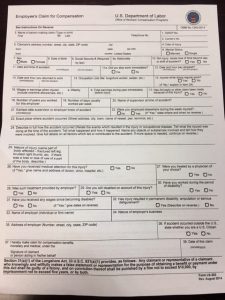 while working overseas for a U.S. contractor/company and which can also provide you with compensation for medical treatment. The first step in filing a Defense Base Act claim is to seek and have proof of medical treatment for any work-related injuries you may have suffered on the job. The injuries you suffered can be physical or mental health injuries or both. Generally, there is a one-year filing deadline to make a claim for benefits after the work-related injury occurred. Filing a DBA claim for PTSD can be more complicated because the symptoms may not arise until after the 1-year deadline has passed. However, PTSD is generally considered an occupational disease which can extend the filing deadline to two-years after knowing of the injury. Here is the form you can use to file your DBA claim. It is called an
 an ALJ is not bound to believe or disbelieve the entirety of a witness’s testimony but may choose to believe only certain portions of the testimony.