Florida Injury Attorneys Blog


Florida Workers Compensation Lien
The workers’ compensation system is designed to provide injured employees with medical and wage loss benefits. Jones v. Martin Elecs., Inc., 932 So.2d, 1104 (Fla.2006).
If you are injured on the job or in the scope of your employment you may have a worker’s compensation claim against your employer/insurance company and you may also have a claim any negligent third-parties.
The injured employee has one year from the date of accident/injury to file a lawsuit against the negligent third-party. The employer, the party paying the worker’ compensation benefits has two years to bring suit. “At the end of the second year, the rights of action revert to the employee, but are (as before) subject to the employer or insurer’s subrogation and lien rights.” Luscomb v. Liberty Mut. Ins. Co., 967 So. 2d 379, 381 (Fla. Dist. Ct. App. 2007).
Although, you may have a workers’ compensation claim against your employer and a claim against any negligent third-party you will not be able to double dip. Florida Statute 440.39 (2020); Jones v. Martin Elecs., Inc., 932 So.2d 1100, 1108 (Fla.2006).
 Florida Statute 440.39 (2020) mandates that an employer who has provided benefits to an injured employee is entitled to place a lien on a settlement from a third-party for the amount that the employer has paid in benefits. The employer can also elect to waive the lien. An employer providing workers’ compensation benefits to an injured employee can place a lien on any monies paid out for medical, wage loss benefits as well as future medical benefits that are part of an employee’s settlement with a negligent third-party. City of Lakeland v. Stapleton, 875 So. 2d 784 (Fla. Dist. Ct. App. 2004).


 Third: What is my hearing loss worth? Compensation for total loss of hearing in one ear is fifty-two (52) weeks and compensation for total loss of hearing in both ears is two hundred (200) weeks. How much loss you have in your hearing can be determined by the results of an audiogram. Next the calculation is made to find out how much compensation you could be entitled to based on your average weekly wage while working for your employer. Let us say for example you worked earning roughly $1,000.00 per month. This would result in an average weekly wage of roughly $230.77 ($12,000 per year divided by 52 weeks). The proper compensation rate would be two-thirds of your average weekly wage, so in this example, the compensation rate would be $153.85. Now let us say, by calculating your audiogram, that you have suffered a 30% loss in both of your ears, also known as binaural hearing loss. To determine how much you could be entitled to for compensation, you would take the 200 weeks (as indicated by the scheduled list in Section (8) of the Act) and multiply by 30% which would equal 60 weeks. This means you could be entitled to 60 weeks’ worth of compensation at a rate of $153.85, which would equal roughly $9,230.40. We also litigate to get you hearing aids if you want them.
 The last employer rule specifically applies in occupational disease cases.
  Did you know that there exists time period in which you must file your Defense Base Act claim in order to be eligible for compensation checks? Have you been told by an adjuster from one of the infamous insurance companies like Gallagher Bassett or AIG that your “statute has run”? In reality, your statute may not have expired at all! As an initial matter, there exists no time limit for medical treatment. This means that even if you had your injury 20 years ago, you are still eligible to file a claim for medical treatment! Medical treatment is never time barred (unless you settle your claim for a lump sum of money, then your medical claim usually closes forever).
 Because London was hit early and hard with this disease, I am directing you to these youtube videos for people who have symptoms lingering after two weeks.
 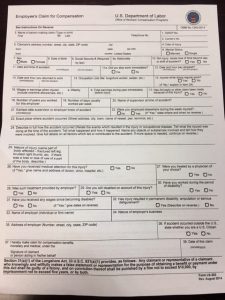 while working overseas for a U.S. contractor/company and which can also provide you with compensation for medical treatment. The first step in filing a Defense Base Act claim is to seek and have proof of medical treatment for any work-related injuries you may have suffered on the job. The injuries you suffered can be physical or mental health injuries or both. Generally, there is a one-year filing deadline to make a claim for benefits after the work-related injury occurred. Filing a DBA claim for PTSD can be more complicated because the symptoms may not arise until after the 1-year deadline has passed. However, PTSD is generally considered an occupational disease which can extend the filing deadline to two-years after knowing of the injury. Here is the form you can use to file your DBA claim. It is called an